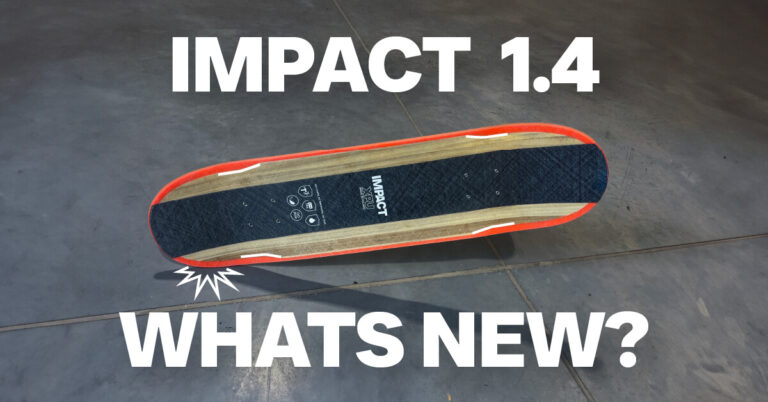

Impact v2.1: What Breaking Skateboard Decks Taught Us About Building Better Ones
A known breaking point, a pneumatic test rig, and a few ideas that didn’t work out. Here’s how we developed our latest construction.
A while ago, we published an article asking whether Impact XPU 1.5 was the final version.
Apparently, we should stop asking that question – it wasn’t.
We were happy with how versions 1.5 and 1.6 performed. Feedback was predominantly positive, especially about durability. But every now and then, someone still managed to break a deck.
And whenever that happens, we have questions.
Not just “How did you do that?” More importantly: “What can we learn from it?”
That curiosity is what led us back to the workshop, through another round of prototypes and material experiments, and eventually to v2.1.
A broken deck – let’s investigate
We publish all the reviews submitted to our website, not just the positive ones. We’re proud of the feedback, but a good overall reputation doesn’t make an individual failure unimportant.
Why does a construction last so well for one skater, while another finds its limits much sooner?
Is it the kind of skating? Repeated awkward landings? A particular obstacle or surface? Or is there something different about that individual deck – an issue with the materials, a manufacturing inconsistency, or something else we need to investigate?
Answering those questions is rarely easy – and sometimes it’s simply impossible. There are so many different forces acting on a deck during skating, and every skater is different: riding style, weight, tricks, spots and landing habits all play a role.
But based on your feedback, our own experience and controlled in-house testing, we can at least try to narrow down the possibilities.
We believe “you landed badly” isn’t a particularly useful place to stop asking questions. Imperfect landings are part of skating, and we are doing our best to make our decks resistant to most of them. We want to understand what happens to the deck when they occur.
And as always, we have to note that our decks are not indestructible. The goal is to make them more durable – and keep finding ways to improve them.
This time, we focused on one particular place where things can go wrong.
Snap behind the truck – can we fix that?
Skate long enough and you may encounter it: a crack or a complete break just behind the truck’s baseplate.
Impact decks aren’t immune to this failure either. Some of you have reported cracks or complete breaks in this area, which gave us a very specific problem to investigate.
Our earlier tests looked at how the tail material resisted abrasion, how chip-resistant our edges were, and how resistant our decks were to breaking behind the truck compared with maple decks.
But the previous setup was mainly demonstrative rather than designed for precise, controlled comparison. It showed that Impact could withstand more than the maple deck we compared it against, but this time we wanted something much more measurable and repeatable.
So the question became: how well could each construction withstand repeated stress around the truck area?
Think about a landing where one foot comes down above the truck area and the other lands close to the tip of the tail.
The tail acts like a lever and bends around the truck area. As the deck flexes, the edge of the baseplate can create a concentrated stress point in the deck directly behind it.
That is the type of loading we wanted our test rig to reproduce.
We suspected this kind of stress contributed to some of the breaks we were seeing. So we built a machine to apply it repeatedly.
Meet our test rig
The setup is fairly straightforward.
One end of the deck is screwed securely to a rigid test table through the truck mounting holes. This represents the supported area around the truck.
At the opposite end, a truck is mounted with its wheels and bearings, just like in a regular skateboard setup. A pneumatic piston presses against the tip of the tail, repeatedly stressing the area we want to investigate.
A simple controller repeats the movement roughly once every three seconds.
Push. Release. Repeat.
We ran nominal two-minute stages at increasing air pressures: 3 bar, 3.5 bar, 4 bar, and upwards. At that interval, a two-minute stage means approximately 40 loading cycles.
The point wasn’t just to make a deck snap dramatically for the camera. It was to create a repeatable test that would let us measure and compare the performance of different constructions.
How does XPU actually compare with other constructions available on the market? Would a different reinforcement help? Would an old idea perform better than expected? Would a material that sounded promising actually improve the result?
The machine gave us a way to start answering those questions without asking a skater to repeat precisely the same landing dozens of times.
Of course, it has limitations. A piston pressing on a tail is not a kickflip down a set of stairs. This test isolates one particular loading situation; it doesn’t reproduce the whole experience of skateboarding.
We didn’t only test our own decks
To give the results some context, we bought two benchmark decks: a well-regarded seven-ply Canadian maple deck and a fiberglass-reinforced maple deck.
We wanted to compare against products skaters actually like, not pick the cheapest board available and congratulate ourselves when it broke.
Alongside those, we tested our existing construction and several experimental variations. Some were developments of v1.6. Others revisited ideas we had considered before.
We experimented with the direction of the reinforcing fibers, the weight of the composite fabrics, and how reinforcement was distributed through the construction.
And yes, we tried Kevlar – some of you suggested it.
For this particular application, it didn’t give us the result we needed.
That doesn’t make Kevlar a bad material. It makes it an unsuccessful option in the configuration we tested. A material’s reputation isn’t enough – it has to work in the actual deck, under the loads we’re trying to address.
That was one of the useful reminders from this process: a more impressive material name doesn’t automatically make a better skateboard.
What actually changed in v2.1?
The final solution came from refining the composite construction rather than simply choosing a different headline material.
We changed the direction and weight of the fiberglass reinforcement and added targeted reinforcement in the truck area, addressing the section we had been investigating.
The question wasn’t only how much reinforcement to use. It was where to put it and how to arrange it.
We’re keeping the exact fiber angles, material quantities and layer arrangement to ourselves. We’re happy to explain the development process, but we’d rather not publish the complete recipe for the competition.
We’re already leaving a few clues here.
The result is v2.1: a direct evolution of the construction introduced with our limited Full Black v2.0 series.
Not a completely unrelated design. Another step in the same development process, informed by what the tests showed us.
What happened on the test rig?
Here are selected results from the test series:
| Deck tested | Air pressure | Time at that pressure | Outcome |
|---|---|---|---|
| Seven-ply Canadian maple benchmark | 4.5 bar | 37 seconds | Broke |
| Fiberglass-reinforced maple benchmark | 4.5 bar | 11 seconds | Broke |
| Impact v1.6 | 5.8 bar | 2 minutes 3 seconds | Broke after completing lower-pressure stages |
| Impact v2.1 test specimen | 6 bar | 2 minutes 19 seconds | Stayed in one piece; a small stress crack was visible. Test stopped for safety. |
The v1.6 deck had already completed stages at 4.5, 5 and 5.5 bar before breaking at 5.8 bar.
The v2.1 specimen reached 6 bar and remained in one piece when we stopped the test.
There’s an important detail here: it did develop a stress crack behind the baseplate.
We’re not going to hide that behind the word “passed.” Remaining in one piece and remaining completely undamaged are two different things. The crack is part of the result, and it’s useful information for the next round of development.
To our surprise, the fiberglass-reinforced maple specimen broke earlier than the standard maple specimen in this test.
That does not establish that reinforced maple decks are generally weaker, or that fiberglass makes a deck worse. But it was definitely an interesting outcome for us.
It describes what happened to those particular decks in this particular setup.
Likewise, these results are not a formula for how many weeks each deck will last under your feet. Real skating is much more complicated.
We believe it is often about the sequence of stresses – what mix of forces you apply to the deck, and in what order.
You might slam into a 50-50 and put a huge load through the deck and truck area. Then a few minutes later you jump a set and land awkwardly on the tail or closer to the center of the deck. Repeat different combinations like that multiple times, add rider weight, specific style and spots, and you could probably find a perfect recipe for breaking almost any deck.
There’s another important part of this equation.
We could make a deck much harder to break simply by making it considerably more flexible. But who wants an unresponsive noodle under their feet? On the other hand, we could build an almost indestructible tank – but then it would be far too heavy, unpleasant to skate, and potentially much more dangerous when it hits you or someone else. Metal decks have been tried in the past, and let’s just say that probably wasn’t the best direction.
The real challenge is finding the right balance between durability, stiffness, weight, pop and proper skateboard feel – and we believe v2.1 gets us closer to that balance.
Watch the complete test
For the tech nerds: what does 6 bar actually mean?
Bar measures pressure, not force. To estimate the cylinder’s pushing force, we also need the piston’s area.
Our test cylinder has a 100 mm piston diameter. Using pressure × piston area, 6 bar gives a theoretical extension force of approximately:
4.7 kN – roughly 480 kg-force.
That is where the “480 kg” figure comes from.
It is a theoretical cylinder-force estimate based on pressure and piston diameter, rather than a measurement of the exact force delivered during every push. Friction, pressure losses and the cylinder’s operating conditions can affect the actual force.
It is also not a 480 kg rider-weight rating. And because we stopped the test rather than continuing until the deck snapped, it is not an established ultimate breaking load.
What we can say is that the v2.1 specimen endured repeated loading at the 6-bar setting for 2 minutes and 19 seconds without snapping, although it showed a stress crack.
That’s a result we’re pleased with – and one we want to describe accurately.
What does this mean when you actually skate?
The practical aim is simple: improve resistance to a failure mode we had seen in real use.
Not a complete win a test that is far from real skating. And not claim that you can land anywhere on the board, under any circumstances, and expect it to survive.
We’re sure there will still be skaters and situations that find the limits of v2.1.
But this time we have controlled test data showing that, in this particular failure mode, v2.1 withstands substantially higher loads than the maple benchmark decks we tested.
That gives us much more confidence in the direction we’ve taken.
We started with reports of decks breaking in a particular area. We developed a test to investigate loading in that area. Then we used it to compare alternative constructions and make changes.
That gives us a reason to be confident in the direction of the development. But it doesn’t finish the job.
The next part happens under skaters’ feet.
We want to hear how the decks feel, how they hold up, and what happens after repeated sessions. Positive feedback matters. So do the cases that don’t go as expected.
A workshop test helps us make decisions. Real skating helps us find out what we still haven’t accounted for.
Is v2.1 the final version?
Probably not.
We’ve asked that question before, and apparently neither we nor the skaters riding our decks are very good at leaving it alone.
Give v2.1 a proper run. Skate your usual spots. Work on the tricks you’ve been chasing. Tell us what feels good and what could be better.
And when something goes wrong, tell us that too. Photos, how long you’ve ridden the deck, what you were skating, and what happened around the time of the break can all help us investigate.
No need to deliberately stomp one in half to contribute to the research.
We have a machine for that.
Keep pushing your skating. We’ll keep working on the decks.